About
Background // Profile
Profile
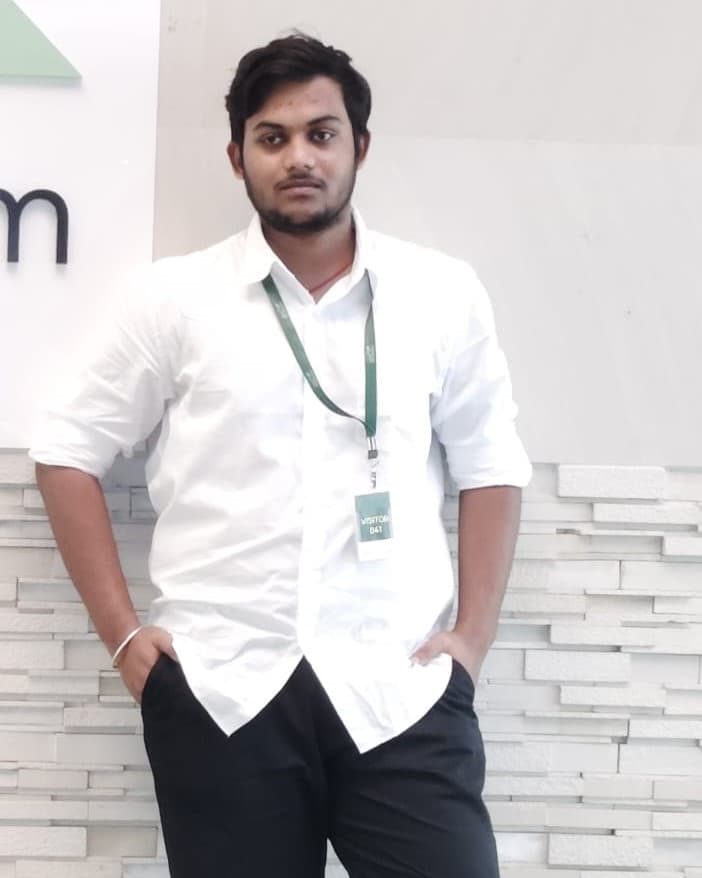
I'm a Computer Science engineer who works at the intersection of low-level systems, hardware-software integration, and industrial embedded applications.
My primary focus is building the underlying logic that allows complex hardware to communicate with the digital world — whether that's writing a 32-bit OS kernel from scratch, implementing BLE data pipelines for radiation detectors, or building POSIX-compliant shells in C.
Philosophy: I don't just write applications — I build the systems they run on.
Systems & Embedded
Bare-metal OS development, BLE hardware integration, POSIX shell implementation, and industrial IoT applications.
Software Engineering
Full-stack mobile and web applications — React Native, Node.js, REST APIs, SQLite — applied to real hardware problems.
Mathematical Reasoning
Probabilistic modelling, Bayesian inference, and statistical analysis — applied to recognition and classification problems.
Education
Geethanjali College of Engineering and Technology
B.Tech in Computer Science and Engineering
Resonance Junior College / RGUKT Basar
Intermediate (MPC) / Pre-University Course
Pallavi Model School
CBSE — Class X
Technical Skills
Click a domain node to drill into the skill tree.
Experience
Experience Timeline // Chronological
A chronological record of internships, engineering roles, and professional engagements.
R&D Engineering Intern, Embedded Systems
@ NUCLEONIX SYSTEMS
Contributed to the development and real-time deployment of the tablet-optimized radiation monitoring mobile application (TAB-Based GM Counting System). Programmed secure client access by retrieving the unique Android Device ID and authenticating it via Supabase-driven Device Based Access Control, integrated Nordic UART Service (NUS) BLE communication with Arduino-based hardware detectors, built backend support with Node.js/REST APIs, and implemented on-device SQLite database structures.
Software Development Engineer Intern
@ AVASAN CHAKRA
As a Software Development Engineer Intern at Avasan Chakra (Startup), I engaged in a two-month remote role starting in April 2026. Reporting directly to the CTO, I was responsible for tackling algorithmic problem-solving and advancing various software development projects. My work actively contributed to the company's mission of driving innovative, sustainable, and eco-friendly solutions tailored for high-rise buildings. This opportunity allowed me to apply my technical skills to meaningful sustainability initiatives within a collaborative environment centered on clarity and precision
PR Head
@ GCET CODING CLUB
Serving as the Public Relations Head of the GCET Coding Club, driving outreach, technical event coordination, and cross-departmental collaborations. Spearheaded multiple initiatives to grow the club's presence, bridge the gap between students and industry professionals, and cultivate a culture of engineering curiosity within the campus ecosystem.
Student Member
@ ISTE
Active member of the Indian Society for Technical Education (ISTE), engaging with a national network of engineering professionals and students. Participating in workshops, seminars, and technical symposia that sharpen both domain expertise and professional acumen — reinforcing a lifelong commitment to continuous learning and engineering excellence.
Webmaster
@ IEEE EdSoc
Operated as Webmaster for IEEE Educational Society, owning the full web infrastructure stack. Designed and maintained web portals used by hundreds of members, implemented backend data pipelines in Python & SQL, and ensured platform uptime and security. Collaborated closely with the chapter leadership to digitize event management workflows and enhance the user experience for a diverse technical audience.
Student Ambassador
Selected as a Google Student Ambassador — a competitive program that identifies high-potential engineering students to represent Google's developer ecosystem on campus. Organized workshops, cloud bootcamps, and hackathons that introduced students to Google's product suite and AI tooling. Acted as a conduit between the campus community and Google's developer relations team, mentoring peers on cloud architecture and responsible AI practices.
Student Member
@ IEEE COMPUTER SOCIETY
Member of the IEEE Computer Society, the world's premier organization for computer science professionals. Engaged in deep technical discourse around algorithms, systems architecture, and emerging paradigms in computing. Access to cutting-edge research publications and participation in student conferences directly sharpened analytical rigor and informed the development approach across hardware and OS-level projects.
Cyber Security Intern
@ SUPRAJA TECHNOLOGIES
Completed an intensive cyber security internship at Supraja Technologies, gaining hands-on exposure to offensive and defensive security methodologies. Conducted penetration tests on simulated network environments using Kali Linux, executed OSINT reconnaissance workflows, and documented vulnerability reports. This experience deepened understanding of attack surfaces at both the network and application layer — knowledge that directly informs how software is written securely at a systems level.
AI Intern
@ AGNIRVA.COM SPACE
Interned at Agnirva, a space-tech AI organization, working at the frontier of generative AI and large language model applications. Contributed to research and development pipelines involving LLM fine-tuning, multi-modal prompt engineering, and AI-assisted data processing for aerospace-adjacent datasets. This role cultivated a rigorous understanding of agentic AI architectures and the ethical deployment of intelligent systems in high-stakes domains.
Selected
Work
A selection of systems, embedded, and software engineering projects — each with real engineering depth.
NeuralMesh | Mempool Threat Topology & GNN Anomaly Engine
Ethereum mempools are adversarial, low-latency environments where frontrunning, sandwich attacks, and toxic MEV exploits occur before block confirmation — rule-based heuristics fail to capture non-linear transaction paths at wire speed. Modeled pending transactions as dynamic directed bipartite graphs (accounts and smart contracts as nodes; state-changing interactions and token transfers as edges). Implemented a multi-head Graph Attention Network (GAT) in PyTorch Geometric with dynamic attention weighting across multi-hop paths, isolating toxic MEV signatures with sub-40ms inference latency. Streamed live pending mempool hashes via Alchemy WebSockets into an async buffer queue for continuous real-time inference. Built an interactive WebGL/Three.js topological visualizer rendering live cluster risk scores and attack vectors in-browser. Architecture: Alchemy WS → Async Buffer → FastAPI → GAT Model → Redis Cache → WebGL Renderer.
Tab-Based GM Counting System
A professional, tablet-optimized radiation monitoring mobile application built for Nucleonix Systems. Authenticates via Supabase Device-Based Access Control using the unique Android Device ID as a hardware license gate. Connects to an Arduino-based Geiger-Müller detector over BLE using the Nordic UART Service (NUS) for real-time CPS/CPM data acquisition. Features an industrial dashboard with 0–1200V helipot stepping, Sample/Standard/Background measurement labeling, on-device SQLite persistence, Node.js REST API integration, and SheetJS spreadsheet export. Architecture: Hardware (GM Detector) → BLE/NUS → React Native → SQLite (local) → Node.js REST API → Supabase (auth).
Hobby-OS — 32-bit x86 Kernel
A custom-built 32-bit x86 operating system kernel written from scratch in C and NASM Assembly. Implements a complete boot sequence: BIOS → bootloader → protected mode → kernel entry. Includes a custom Global Descriptor Table (GDT), Interrupt Descriptor Table (IDT) with 256 entries, hardware interrupt remapping via 8259 PIC, Programmable Interval Timer (PIT), paging with identity mapping and higher-half kernel layout, heap allocator, VGA framebuffer text output, keyboard IRQ handler, and system calls via int 0x80 with ring-3 privilege separation. Built and emulated with QEMU.
Probabilistic Character Recognition Engine
A probabilistic character recognition engine built in R using recursive Bayesian updating to solve sequential classification problems. Implements a stochastic smoothing function with a 0.9/0.1 likelihood ratio, MAP estimation for noise-corrupted inputs, and convergence detection at a 0.85 posterior probability threshold. Designed to handle contradictory sequential observations in real time — demonstrating how Bayesian inference outperforms deterministic matching under noisy conditions.
Custom Linux Shell
A functional Unix-like shell implemented from scratch in C, closely following POSIX semantics. Implements the full read-eval-print loop (REPL), process creation via fork()/exec(), piping between commands using pipe() and dup2() for stdin/stdout redirection, signal handling for Ctrl-C and Ctrl-Z, background job execution with &, and built-in commands (cd, exit, history). Demonstrates direct use of low-level POSIX system calls without library abstractions.
Student Attendance System
Automated student attendance system using facial biometric identification. Captures real-time video, detects faces using OpenCV, matches against enrolled student profiles using recognition algorithms, and logs attendance records to an SQL database. Eliminates manual roll-call with a fully automated biometric pipeline.
Eat-IQ | Nutrition Tracker
A web application for tracking dietary intake and nutritional goals. The core food recognition feature uses a third-party Vision AI API; my contribution was the React.js frontend, data visualization dashboard for caloric and hydration tracking, and the application architecture and state management.
Honors & Awards
Get In Touch
Open to Systems / Embedded / SDE roles and internships. Happy to discuss hardware integration, OS internals, or anything you'd like to collaborate on.
mourya.birru@gmail.com